

 AliShokoohi.est
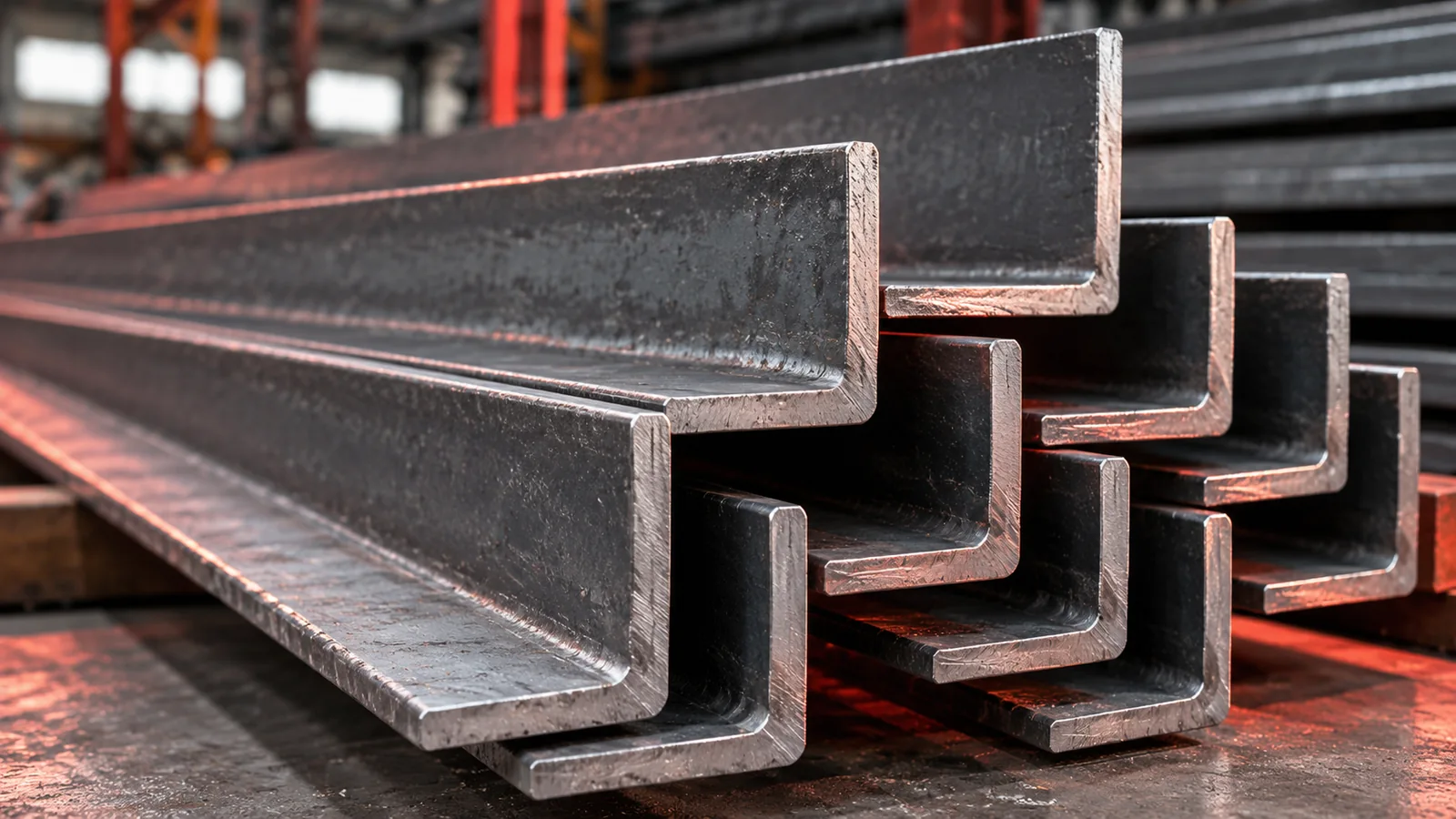
A steel angle, often called angle iron or an L-section, is a metal profile with two connected legs that generally form a nominal 90-degree angle. Its apparently simple geometry is useful in brackets, frames, supports and many structural details, but correct selection depends on much more than appearance. This NFPK technical guide explains what a steel angle is, how to read its dimensions, which manufacturing methods and steel grades are involved, where angles are used, how their mass is estimated and what a delivery inspection should cover.
This page is a technical introduction rather than a purchase quotation or structural design recommendation. For ordering criteria, see the complete steel angle buying guide. For an explanation of pricing factors, see our article on steel angle pricing.
What is a steel angle, and what are its components?
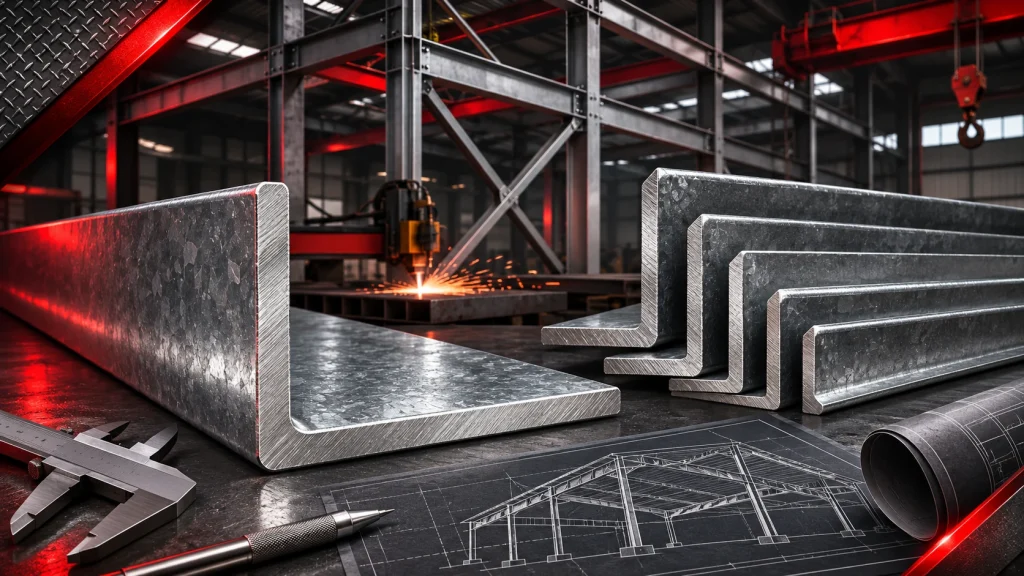
A steel angle is an open section with an L-shaped cross-section. It comprises two flat legs joined at a corner, with an inside root radius and outside corner geometry determined by the production method. A steel angle is not a U-channel, a hollow square section or an I-beam. Its leg widths, nominal thickness and length must be specified separately.
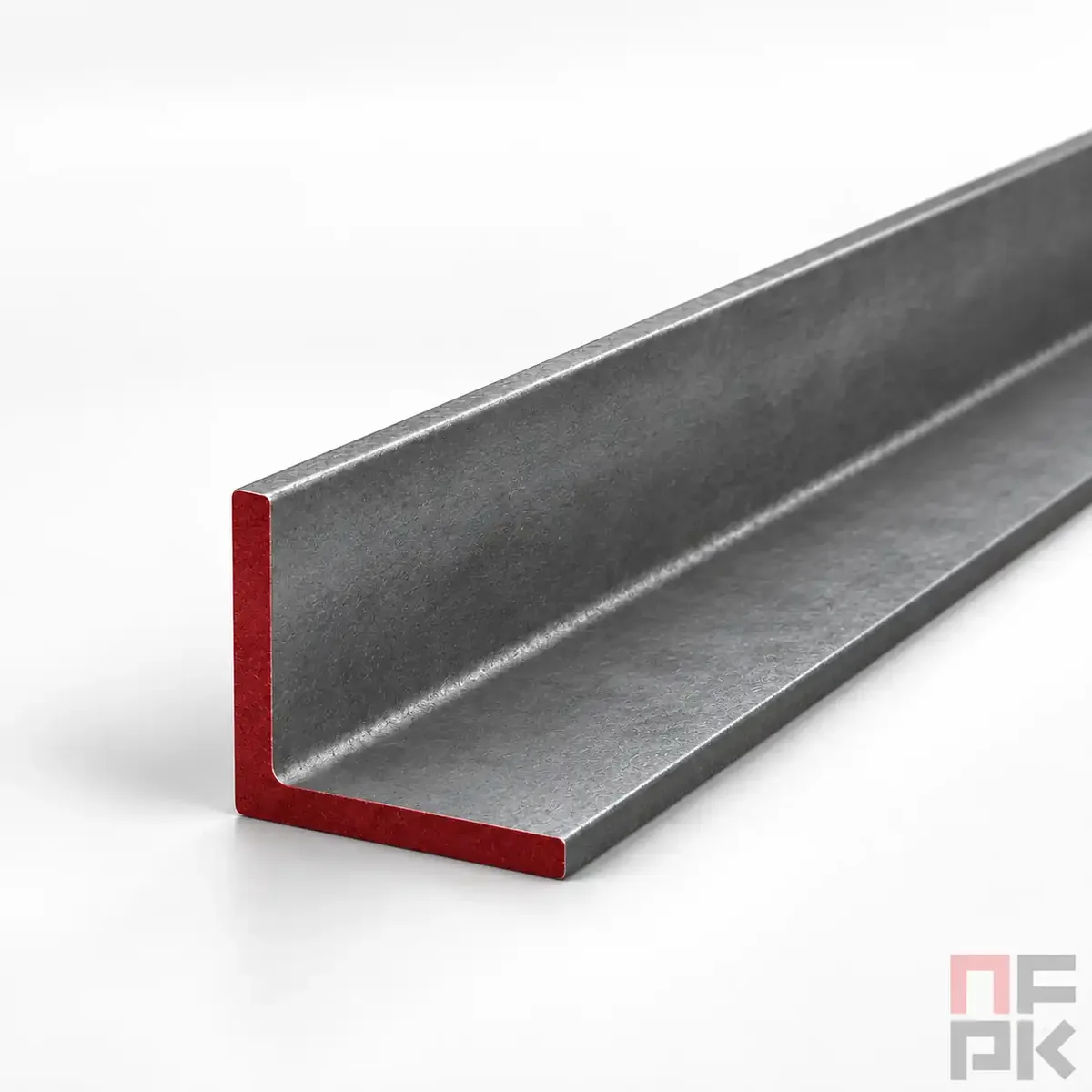
For a typical equal-leg hot-rolled angle, the cross-section has two legs of equal nominal width. Other products have unequal legs. A cut end of a genuine equal-leg angle clearly shows the two straight legs meeting at approximately a right angle; rolled corners can be slightly rounded, which does not turn the section into a different profile.
What does the 90-degree angle mean?
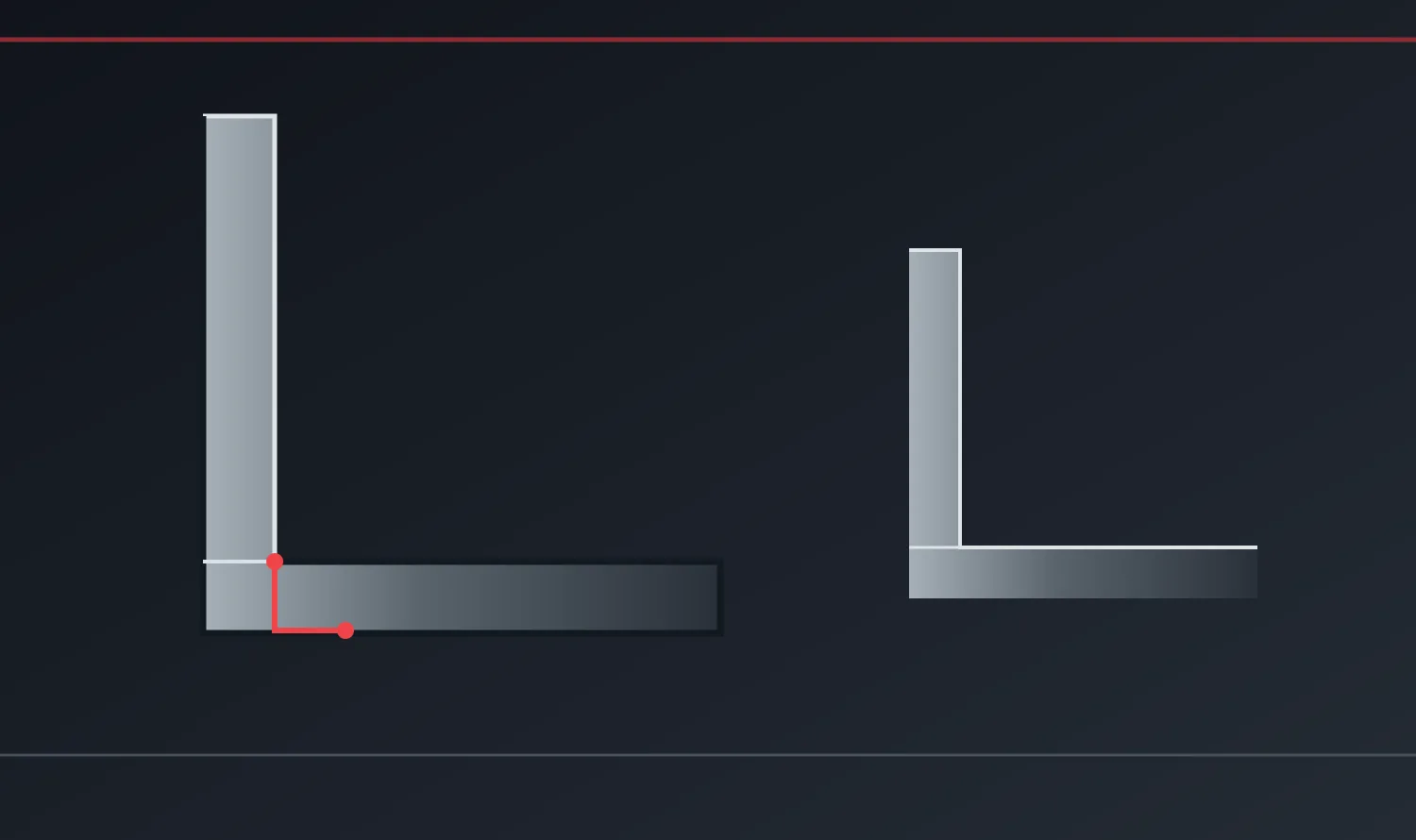
The nominal included angle between the legs is 90°. Real manufactured pieces are subject to permitted out-of-square tolerances, so a production angle is not necessarily mathematically perfect at every point. For acceptance, compare measurements with the applicable product standard and the agreed specification rather than assuming zero deviation.
Leg width, thickness and stock length are not the same measurement
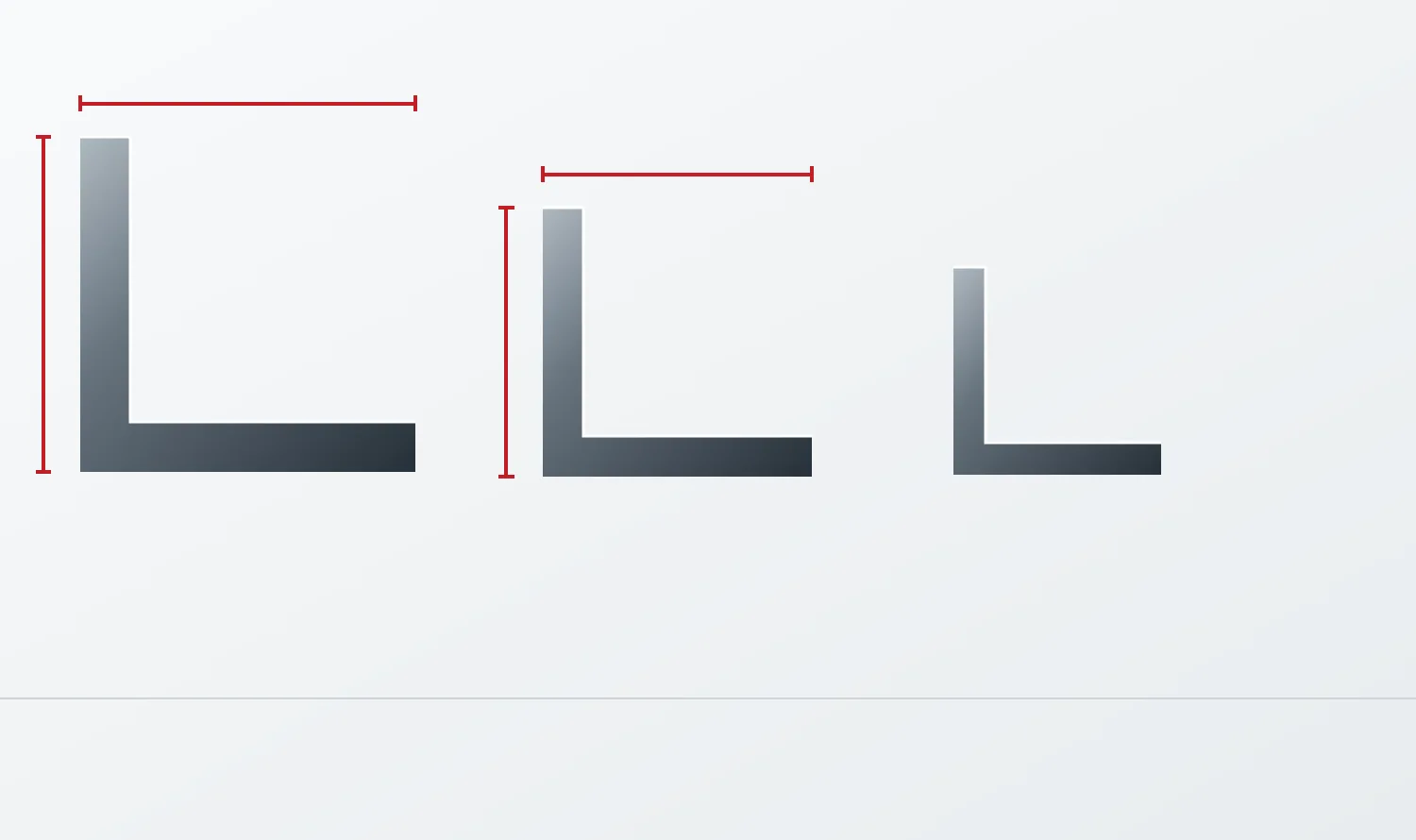
Leg width describes the nominal span of each side of the L; thickness describes the material thickness in the legs; and stock length describes the length of the bar along its longitudinal axis. A designation such as 40 × 40 × 2.8 mm ordinarily means two 40 mm legs and a nominal 2.8 mm thickness—not a 2.8 m length. Stock length, grade, manufacturing route and mass per piece must be confirmed separately.
Types of steel angle by cross-sectional geometry
Equal-leg steel angles
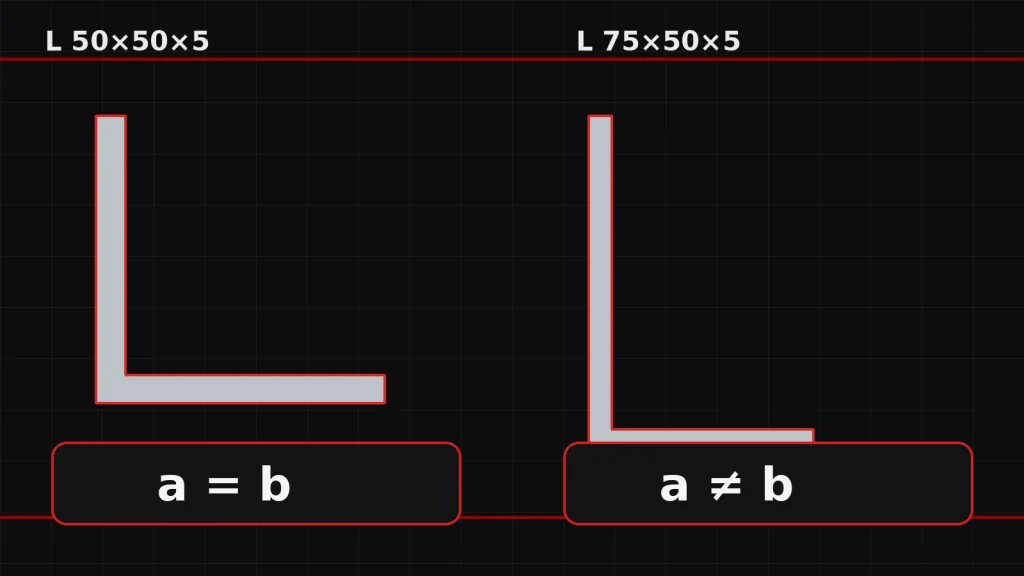
An equal-leg angle has two legs with the same nominal width, such as 30 × 30, 40 × 40 or 50 × 50 mm. The symmetry of the leg dimensions does not make every mechanical property symmetric about every loading axis; bending, torsion and connection eccentricity still require consideration. Use exact dimensional and material specifications for engineering applications.
Unequal-leg steel angles
An unequal-leg angle has legs of different nominal widths, such as 50 × 30 mm. It may suit details that need different bearing or connection surfaces, but it is not inherently better or stronger. The longer leg, orientation, load path, buckling length and fastener or weld positions affect performance. Always verify whether the design calls for equal or unequal legs.
Both varieties belong to the L-angle family. They should not be confused with a channel having two flanges on the same side of a web.
Hot-rolled versus press-braked steel angles
In everyday trade, a mill-produced (hot-rolled) angle and a formed or press-braked angle may be discussed as though they were equivalent. They are not necessarily interchangeable. Manufacturing route influences corner radius, section properties, available thicknesses, tolerances and the standards under which a particular product is supplied.
How are hot-rolled angles produced?
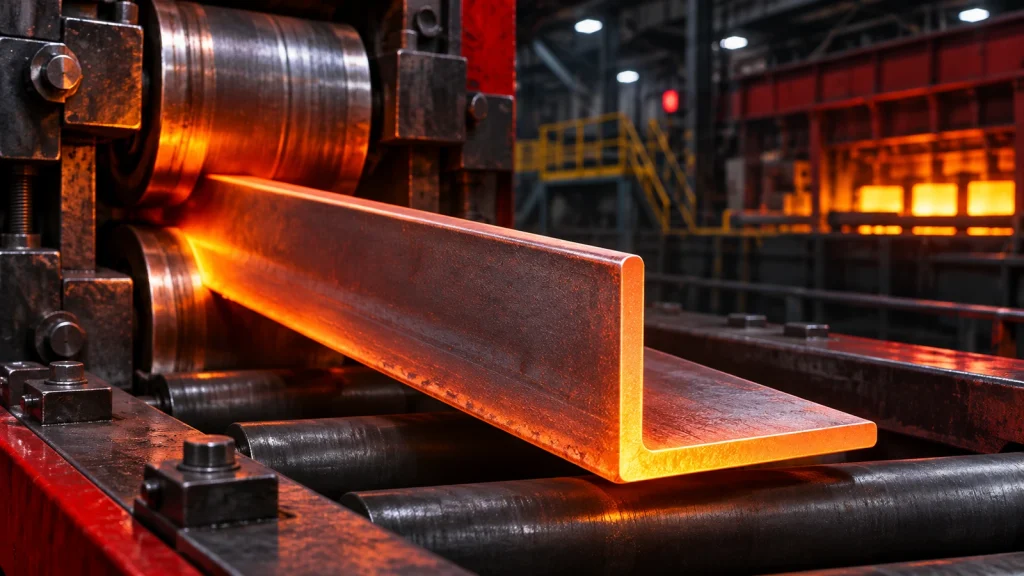
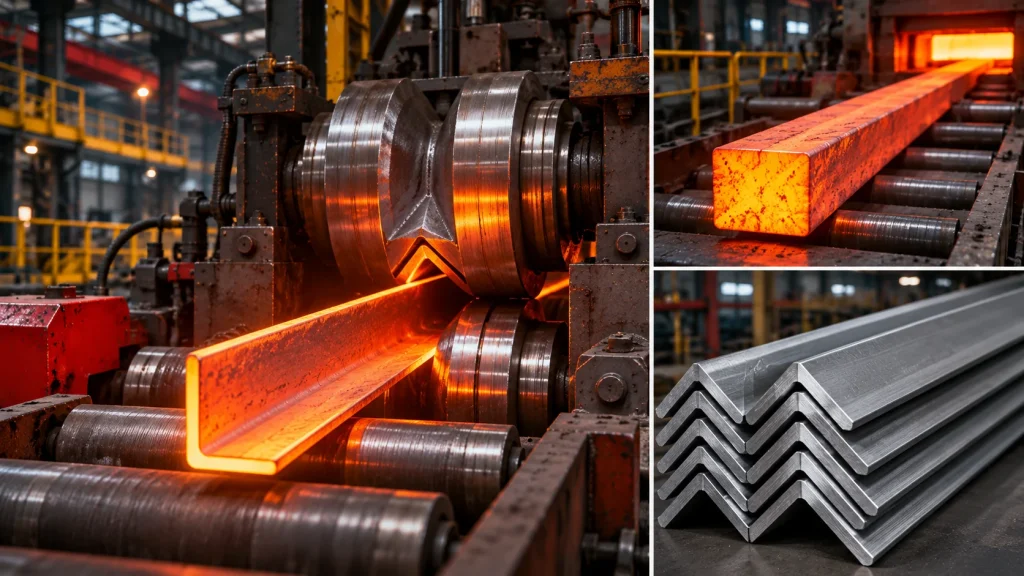
Hot-rolled angles are shaped by successive rolls while steel is at an elevated temperature. The bar emerges with an L-shaped section and characteristic root and toe radii, then is cooled, straightened and cut to specified lengths. Dimensions and tolerances for certain structural hot-rolled equal- and unequal-leg angles are covered by the EN 10056 standards. The product’s mechanical grade and technical delivery conditions are separate requirements.
How are formed angles produced?
Press-braked angles are generally made by bending sheet or strip into an L-shaped section. Their bend radii and dimensional properties can differ from those of rolled angles, even when both display the same nominal leg dimensions. A drawing calling for a hot-rolled structural angle should not automatically be fulfilled with a bent strip without the designer’s approval and relevant documentation.
For specification-sensitive work, compare the manufacturing method, steel grade, dimensional tolerances, corner radius and proof of conformity, not just the printed size.
| Comparison point | Hot-rolled angle | Press-braked angle |
|---|---|---|
| Production route | Angle section formed by rolls | Steel sheet or strip bent to L profile |
| Corner geometry | Determined by rolls and product standard | Determined by forming tools and bend radius |
| Load-bearing suitability | Depends on grade, standard and design | Depends on grade, standard and design |
| Quality evidence | Dimensions, tolerances, material and certificates | Dimensions, tolerances, material and certificates |
Which steel grades are used for angle bars?
The word “angle” identifies a shape, not a steel grade. Common carbon structural steels and, for specific applications, other alloy families may be formed into L-sections. In European specifications, grades such as S235 and S275 are familiar examples, but no angle should be described as having a particular grade without supporting mill or supplier documentation.
Likewise, a trade designation such as “ST37” is not a substitute for verifying the actual grade and applicable product standard. Ask for the material certificate, heat or batch traceability and relevant mechanical or chemical requirements whenever the design or purchase order calls for them. Surface color and the marketing description alone are not proof of grade.
Where are steel angles used?
Connections, brackets and reinforcement details
Two approximately perpendicular legs provide convenient faces for bolted or welded joints, brackets, edge supports and fabricated assemblies. However, bolt-hole geometry, edge distances, weld dimensions, connection eccentricity and applied forces must be designed. An L-profile does not automatically have sufficient load-bearing capacity simply because it looks heavy.
Trusses, bracing and steel frames
Angles may be used singly or in pairs as members of trusses, bracing systems and other steel assemblies. Their behavior depends on the direction of loading, unbraced length, connection details, torsional response and risk of buckling. Two sections of equal mass may behave very differently, so substitution requires engineering assessment.
Machine bases and workshop structures
Equipment frames, fixtures, tables and support brackets can use angles because the profile is straightforward to cut, drill, bolt and weld. In addition to dead load, consider vibration, impact, fatigue, corrosion and long-term maintenance. Coating and surface preparation requirements vary with the environment.
Service supports and non-structural framing
Angles also appear in pipe or cable support frames, shelving systems, secondary members and miscellaneous metalwork. Outdoors and in humid or chemically aggressive locations, an appropriate coating, painting or galvanizing system may be necessary. These uses should still follow the project’s loading and installation requirements.
Advantages and limitations of L-shaped steel sections
An open L-section gives direct access to its faces for machining and joining, fits many straightforward connection details and can be supplied in a wide range of nominal sizes. Its geometry is easy to recognize and to check visually. These are practical advantages rather than a guarantee that the profile is structurally efficient for every load case.
Because an angle is an open, unsymmetrical section about certain axes, it may be sensitive to torsion and eccentric loading. Slender compression members can buckle, while local bending and connection behavior may govern performance. Choosing thickness solely to maximize mass is neither economical nor a substitute for design.
Which standards apply to structural steel angles?
EN 10056-1:2017 specifies nominal dimensions for certain hot-rolled structural steel equal- and unequal-leg angles. EN 10056-2 concerns permissible deviations in shape and dimensions, including relevant mass tolerances. Material grades and technical delivery requirements are addressed separately, for example by relevant parts of EN 10025.
Do not assume that an EN 10056 dimensional reference certifies the steel’s mechanical properties. Also do not apply requirements designed for hot-rolled structural angles uncritically to press-braked, stainless, coated or other specialized products. The agreed standard edition, grade and inspection documentation must match the order.
How is the weight of steel angle calculated?
To estimate mass, begin with the cross-sectional area. For a simplified equal-leg angle with nominal leg width b and uniform thickness t in millimetres, ignoring rolled radii, A ≈ 2bt − t² in mm². Using a conventional steel density of 7,850 kg/m³, approximate mass per metre is A × 0.00785 kg/m.
For 40 × 40 × 2.5 mm, A ≈ 2 × 40 × 2.5 − 2.5² = 193.75 mm². Estimated mass is therefore about 1.52 kg/m, or approximately 9.13 kg for a 6 m bar. These are geometric estimates, not guaranteed weights for any particular manufacturer. Actual rolled radii, production deviations and the agreed weighing method affect commercial weight.
| Parameter | Meaning | Typical unit |
|---|---|---|
| b or a | Nominal leg width | mm |
| t | Nominal leg thickness | mm |
| L | Stock-bar length | m |
| m | Mass per metre or per bar | kg |
For how mass affects the purchase budget, see our article on steel angle pricing.
What is the difference between light and heavy angles?
“Lightweight” and “heavyweight” are often relative trading terms, not independently sufficient grades or quality classifications. Two angles that look similar can have different masses because of thickness, corner geometry, bar length or tolerances. A lighter bar is not necessarily defective, and a heavier one is not necessarily the appropriate choice. Check the specified dimensions, standard, steel grade, measured mass and intended use.
How should angle steel be inspected?
Receiving inspection normally starts by comparing the delivered goods with the purchase order: L-section geometry, equal or unequal legs as specified, nominal width, thickness, length, quantity and material documentation. Use calibrated or appropriate measuring tools at agreed sample positions; check straightness, excessive twist, edge defects, visible damage and corrosion in the context of the acceptance criteria.
Where the project demands proof of mechanical properties, a visual inspection cannot replace mill certificates or laboratory testing. Keep delivery tickets and any measurements linked to the corresponding batch or heat number.
What does not prove quality by itself?
Surface shine, a dark or bright finish, the apparent heaviness of a single bar or one thickness measurement does not conclusively establish compliance. Structural suitability depends on the applicable grade, geometry, tolerances, connection design and verified documentation.
Steel angle vs channel, I-beam and box section
| Profile | Typical cross-section | Principal difference |
|---|---|---|
| Steel angle | L | Two connected legs, normally at 90° |
| Channel | U or C | A web with two flanges |
| I/H beam | I or H | Central web and two primary flanges |
| Hollow section | Closed square or rectangle | A closed-walled cross-section |
Even if sections have similar weights, their bending stiffness, torsional response, connection methods and stability may differ significantly. They are not direct substitutes without design verification.
How do you read an angle specification in a catalog?
The designation 40 × 40 × 2.8 usually indicates equal nominal leg widths of 40 mm and a nominal thickness of 2.8 mm. It does not identify stock length, grade, mill, standard, coating, actual bar weight or availability. the steel angle catalog Review the product’s detailed specification and obtain a current quote before ordering.
For instance, NFPK lists a 40 × 40 × 2.8 model as a catalog example. Its existence in the catalog should not be taken as confirmation of permanent inventory or suitability for all structural uses. the 40 × 40 × 2.8 steel angle product page
Conclusion: what matters when identifying an L-angle?
A steel angle is an L-shaped profile with two connected legs that usually meet at a nominal right angle. The legs may be equal or unequal and the product may be rolled or formed. A sound technical description must identify leg dimensions, thickness, bar length, steel grade, manufacturing route, applicable standard and intended application. To turn this knowledge into a purchase specification, continue with the complete steel angle buying guide and browse the steel angle catalog.
Frequently asked questions about steel angles
What shape is a steel angle?
Its cross-section is shaped like the letter L. Two legs meet at a nominal 90° angle, although real rolled corner radii and dimensional tolerances apply.
What is an equal-leg angle?
It has two legs of identical nominal width, for example 40 × 40 mm. Thickness and stock length must still be specified.
Is a hot-rolled angle always better than a formed angle?
No. They are different production routes. Fitness depends on the required standard, material grade, dimensions and engineering use.
What does 40 × 40 × 3 mean?
Two nominal 40 mm legs and 3 mm nominal thickness. Those figures alone do not establish grade, bar length or mass.
Where are steel angles used?
In brackets, frames, trusses, bracing, machine bases and support assemblies. Structural load capacity must be verified for the exact application.
What is covered by EN 10056?
It addresses dimensions and tolerances for certain hot-rolled equal- and unequal-leg structural steel angles; steel material grades are specified separately.
How can I estimate steel angle weight?
For an ideal equal-leg cross-section, use A ≈ 2bt − t² and multiply A in mm² by 0.00785 to estimate kg/m. Actual rolled shapes may differ.
Is the included angle always exactly 90°?
It is nominally a right angle, with permitted deviations defined by the relevant tolerance specification.
Can I select an angle using weight alone?
No. Mass does not establish grade, buckling behavior, joint performance or the load capacity required by the design.

Comments
0