

 AliShokoohi.est
Buying steel angle bars involves more than comparing a price per length. In this complete steel angle buying guide, we explain how to specify L-shaped steel angles, compare equal and unequal legs, distinguish hot-rolled and cold-formed products, estimate weight, evaluate quotations and inspect a delivery. The goal is to help procurement teams, contractors and workshops order material that matches the project documents rather than choosing by appearance alone.
At Steel Parse Kaveh (NFPK), the following guide is intended as practical purchasing information. It does not replace structural calculations, project specifications or the approval of a qualified engineer.
What is a steel angle bar and how is it specified?
A steel angle is a structural or general-purpose steel section with an approximately L-shaped cross-section, formed by two connected legs. A complete purchasing description should identify leg dimensions, nominal thickness, length, steel grade, manufacturing route, quantity and applicable specifications.
For example, 40×40×2.5 mm usually describes an equal-leg angle with two nominal 40 mm legs and a nominal thickness of 2.5 mm. It does not by itself define stock length, tolerances, steel grade or weight per piece. Confirm those separately on the quotation.
Types of steel angles: leg geometry and production method
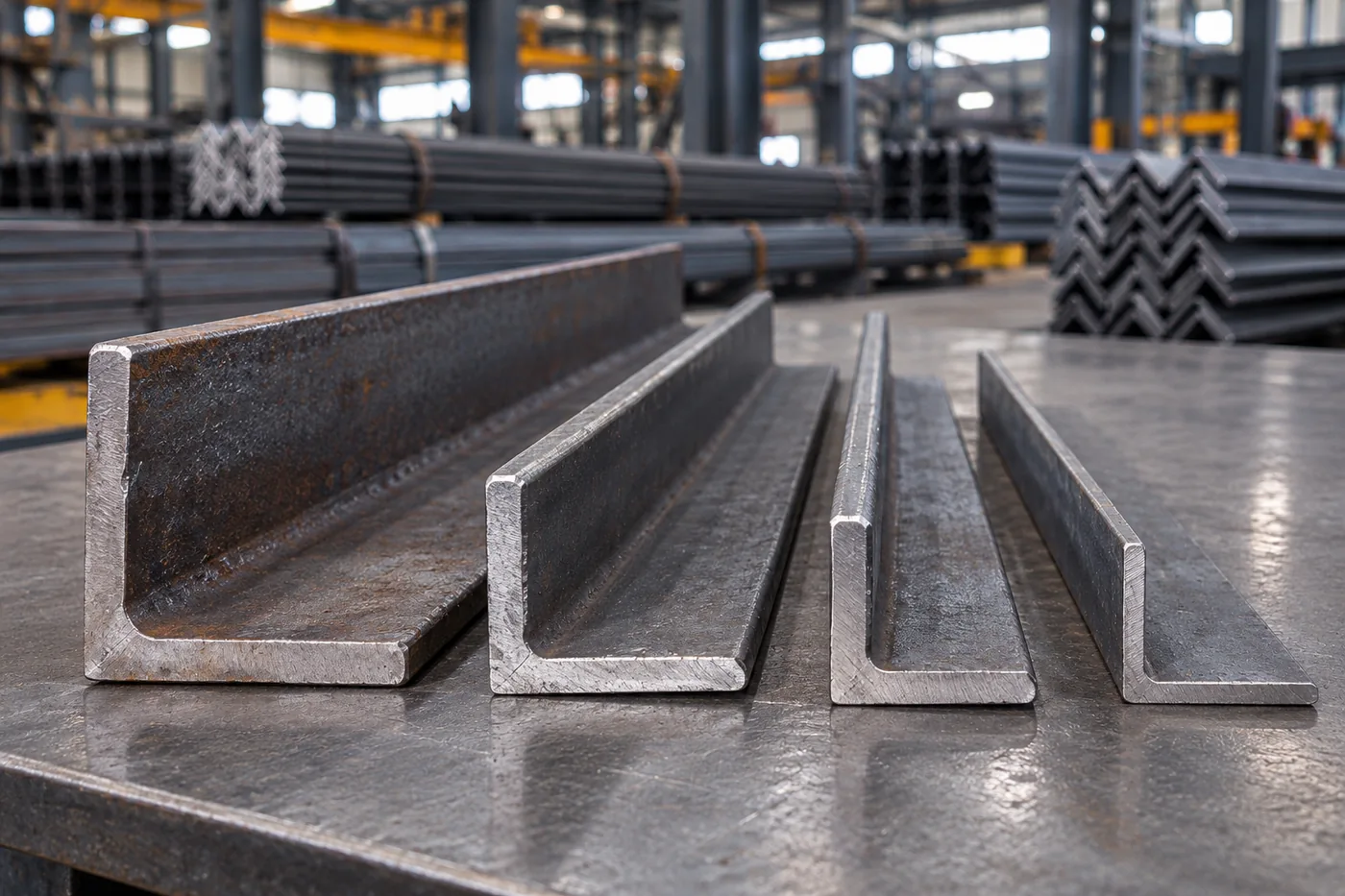
Equal-leg versus unequal-leg angles
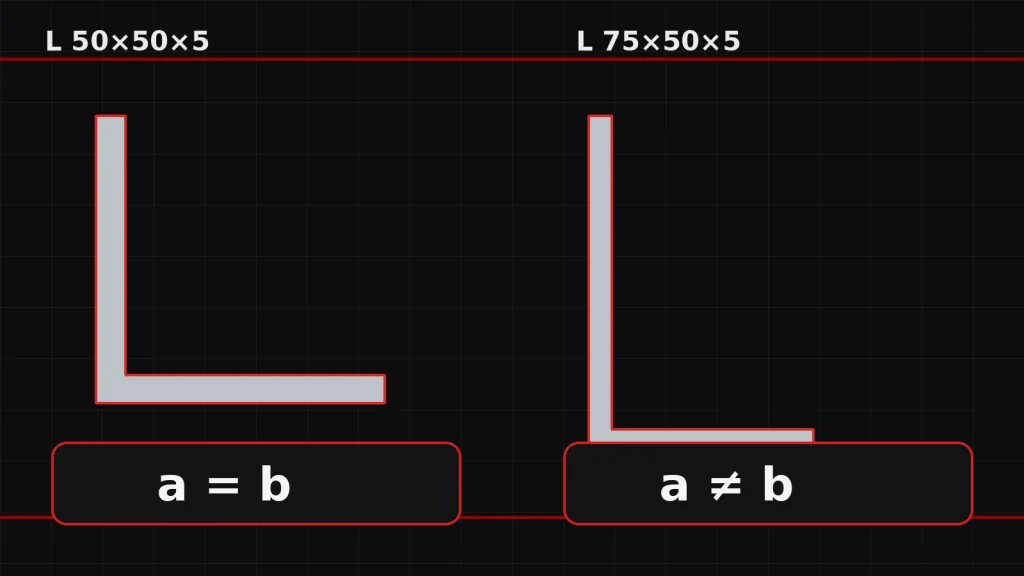
An equal-leg angle has two legs of the same nominal size (such as 40×40 mm). An unequal-leg angle has legs of different nominal widths (such as 50×30 mm). Neither is inherently the stronger choice for every application: loading, connection details and engineering design determine suitability.
Hot-rolled (mill-produced) versus press-braked angles
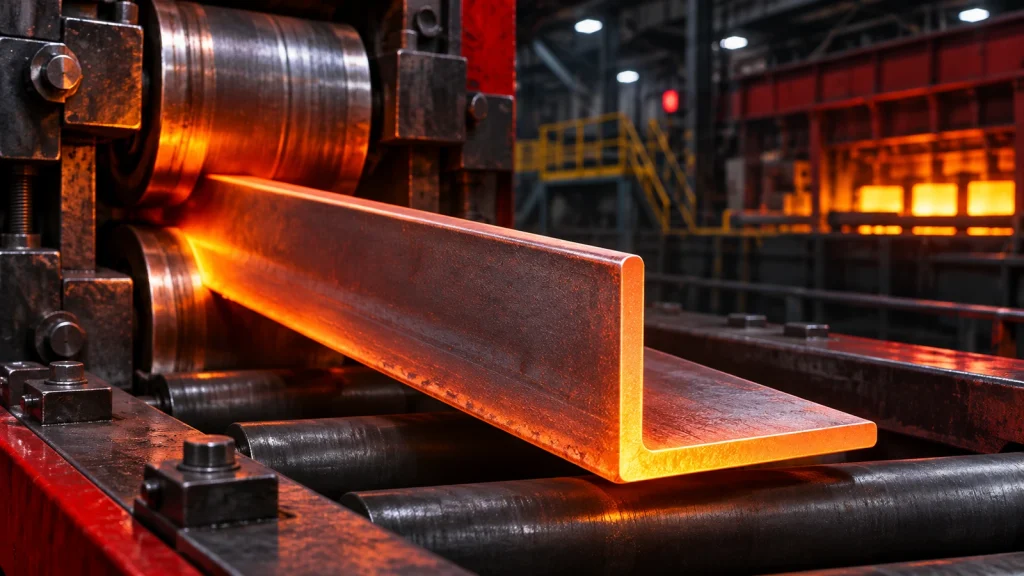
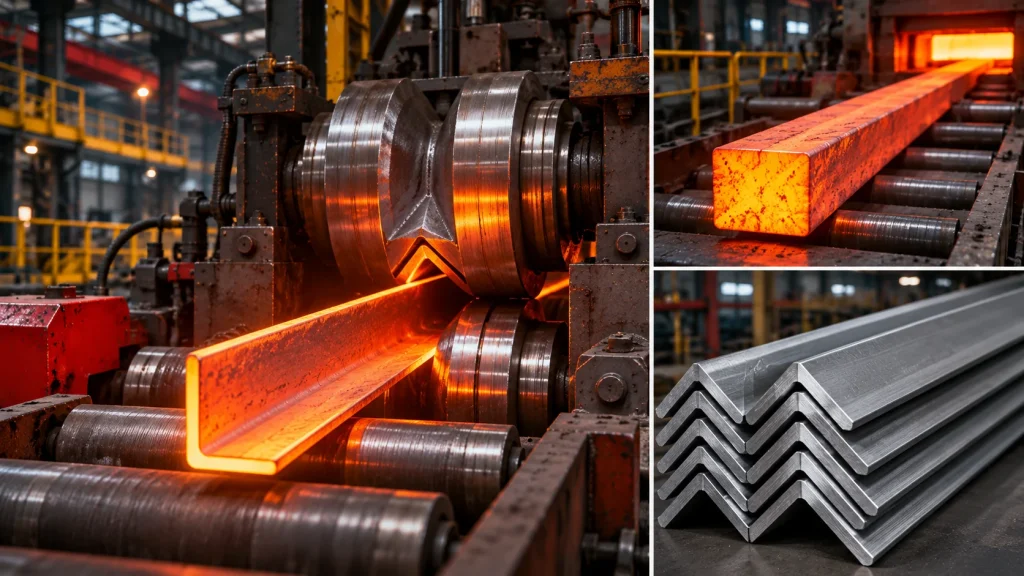
Mill-produced angles are formed as angular sections during rolling. Press-braked or cold-formed angles are made by bending plate or strip. They may differ in corner radii, dimensional tolerances, section properties, available thicknesses and specification. Do not treat both manufacturing methods as interchangeable without checking the required standard and design.
How to choose the right steel angle size and thickness
Start with the construction drawing or bill of materials (BOM), not a generic weight chart. Check the following before asking for a price:
- Is the angle used in a frame, bracket, connection, support, bracing or non-structural assembly?
- What leg widths, nominal thickness, cut length and material grade are specified?
- Will the component face corrosion, repeated loading, impact or vibration?
- Is welding, drilling, coating or galvanizing required?
- Are there restrictions on bolt holes, clearance and connection geometry?
For repeat orders, create a consistent material code for the full specification. Weight comparisons cannot replace structural checks for load-bearing members.
Compare common NFPK catalog sizes
Our catalog lists several angle dimensions you can compare against your purchase requirements. The following are examples for inquiry, not statements of current stock or engineering approval:
- 30×30×2.5 mm angle: compare for orders requiring smaller nominal legs. View specifications for steel angle 30×30×2.5 mm
- 40×40×2 mm angle: examine when the drawings specify 2 mm nominal thickness. View specifications for steel angle 40×40×2 mm
- 40×40×2.5 mm angle: compare with adjacent thickness options. View specifications for steel angle 40×40×2.5 mm
- 40×40×2.8 mm angle: a distinct nominal thickness requiring specification verification. View specifications for steel angle 40×40×2.8 mm
- 40×40×3 mm angle: request a quote when this exact section is required. View specifications for steel angle 40×40×3 mm
Consult individual product pages for technical details, then confirm live availability with sales. Browse steel angle products
How to estimate the weight of a steel angle
When a quote is based on mass, approximate section weight helps estimate quantities, freight and budget. Assuming a sharp inner corner, uniform thickness and a steel density of 7,850 kg/m³, an equal-leg angle has a simplified cross-sectional area of 2bt − t², where b and t are measured in millimetres.
Approximate mass per metre (kg/m) = (2 × leg width × thickness − thickness²) × 0.00785.
For unequal legs of widths a and b, use (a + b) × t − t² for the simplified area before applying the same mass coefficient.
Worked example: 40×40×2.5 mm angle, 6 m length
Area ≈ (2 × 40 × 2.5) − 2.5² = 193.75 mm²; mass per metre ≈ 193.75 × 0.00785 = 1.52 kg/m. A 6 m length therefore weighs approximately 9.13 kg by this simplified model.
Important: real hot-rolled angles have root and toe radii and permissible dimensional deviations. For commercial settlement or acceptance, use the agreed manufacturer’s table, relevant standard and documented scale weight, not the simplified number alone.
Lightweight and heavyweight angles: what matters?
Market labels such as “light” and “heavy” often refer to relative section weight, but they are not sufficient technical specifications. Two pieces with similar nominal dimensions can differ because of actual thickness, rolling radii, length or manufacturing tolerances. Compare grade, nominal dimensions, measured mass per piece, length and agreed weighing method before evaluating price.
A heavier profile is not automatically better, just as a lighter profile is not necessarily defective. Compliance with project requirements is decisive.
Which standards and steel grades should buyers check?
Keep dimensional standards separate from material grade and delivery conditions. EN 10056-1:2017 addresses nominal dimensions of hot-rolled equal- and unequal-leg structural steel angles. EN 10056-2 addresses tolerances on shape and dimensions. EN 10025-2:2019 covers technical delivery conditions for certain non-alloy structural steels.
Names such as S235JR or S275JR are examples of structural steel grades; do not assume that an NFPK-listed angle has any specific grade without the manufacturer’s documentation. Ask for test certificates and heat traceability when the project requires them.
What determines steel angle prices?
- Leg size, thickness and length: all influence overall material mass.
- Actual weight and pricing unit: distinguish per-piece from per-kilogram quotations.
- Steel grade, manufacturing method and mill: confirm the technical basis for comparing offers.
- Order volume and stock availability: small and bulk orders may have different conditions.
- Delivery destination and handling: account for loading, packaging, transport and unloading.
- Taxes, payment and lead time: compare total delivered costs.
Steel prices can change rapidly. Obtain an up-to-date written quotation and compare offers with identical specifications and delivery terms rather than relying on an old published price.
Quality inspection checklist upon delivery
- Order conformity: check leg dimensions, thickness, grade, cut length and piece count against the purchase order.
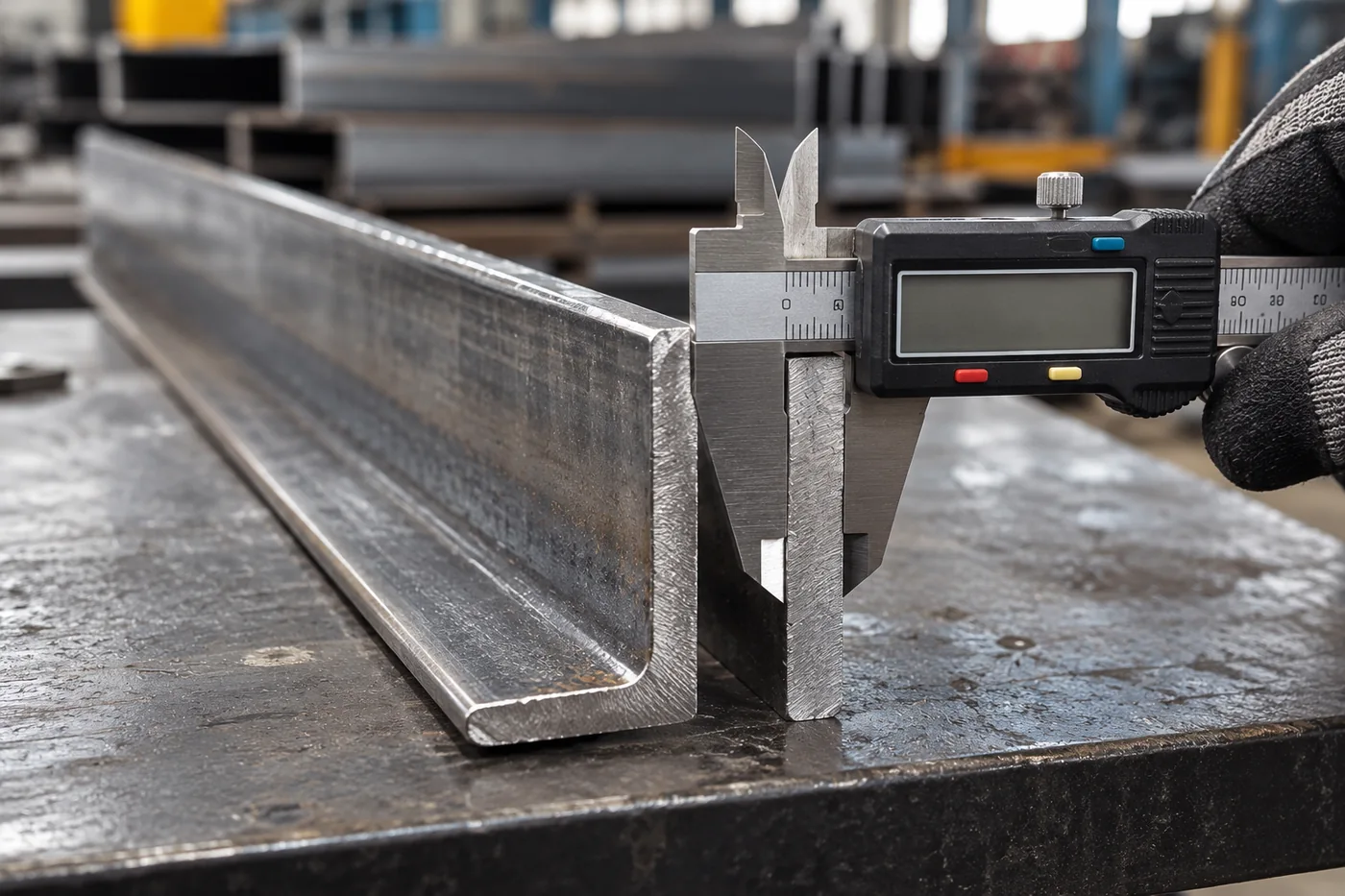
- Sample measurements: use suitable measuring tools and the tolerances of the agreed standard.
- Visual condition: document abnormal twisting, bending, damage, corrosion or edge defects.
- Mass verification: review the agreed calculation or scale ticket.
- Certificates and traceability: collect required mill certificates and heat/batch references.
- Record discrepancies: photograph and report shortages or nonconformities before cutting or installation.
A visual inspection is not a substitute for mechanical testing where the contract or structural specification requires it.
Common mistakes when buying angle iron
- Ordering “40 mm angle” without confirming thickness and length.
- Comparing quotations that use different piece weights or grades.
- Assuming that all angles of the same nominal size weigh exactly the same.
- Choosing thickness based only on price, without checking engineering drawings.
- Ignoring taxes, transport and loading conditions.
- Failing to check the delivery documents and sample dimensions.
How to request and order angles from Steel Parse Kaveh
- Prepare the technical specification: leg geometry, thickness, length, grade and applicable standard.
- Calculate quantities: number of lengths, anticipated cutting loss and approximate tonnage.
- Review catalog items: match the listed dimensions with the BOM. Browse steel angle products
- Request an itemized quote: price basis, location, availability, lead time and freight.
- Verify the pro forma invoice: exact specifications and total charges.
- Inspect delivery: match the shipment to the order and certificates.
Send the sales team the relevant drawing or material list when checking stock and sourcing options. Final structural member selection remains the responsibility of a qualified designer.
Frequently asked questions about buying steel angles
What is the difference between rolled and press-braked steel angles?
Rolled angles are shaped during rolling; press-braked angles are formed by bending steel plate or strip. Their dimensions, corner radii and tolerances may differ, so confirm suitability against the project specification.
How much does a 6 m long 40×40×2.5 mm steel angle weigh?
A simplified rectangular-area calculation yields approximately 9.13 kg. Actual mass depends on corner radii, dimensions and production tolerances; verify against accepted weight documentation.
Should I buy steel angles by weight or per piece?
Either approach can be valid. The quotation must clearly state piece count, length, agreed mass basis and total payable amount.
Does lightweight angle iron always mean lower quality?
No. Section weight alone is not a quality grade. Check whether material, dimensions, tolerances and application meet the requirements.
What details are essential for a steel angle inquiry?
Leg dimensions, thickness, length, quantity or tonnage, steel grade and standard where applicable, delivery location and required date.
Can a steel angle be selected for structural use from a weight table alone?
No. Weight tables support mass and cost estimates, not member resistance, stability or connection design.
Final steel angle purchasing checklist
Before confirming an order, specify section dimensions, thickness, material grade, stock or cut length, quantity, weight basis, inspection requirements and delivery terms. Compare like-for-like quotations, verify live stock and prices, and review the available options in Browse steel angle products.

Comments
0