

 AliShokoohi.est
Digital transformation in the steel industry becomes valuable when it goes beyond the visual appearance of a website and gradually becomes part of real sales operations, customer communication, management decisions, and brand experience. The future vision for the Navard Foolad Parseh Kaveh website follows this principle: move from a professional information platform toward an operational digital environment for calculation, quotation, ordering, performance analysis, and eventually intelligent customer assistance.
This article presents the proposed NFPK digital roadmap based on the current website and the planned development stages. Phase 1 is the existing digital foundation for presenting the company, products, technical specifications, prices, specialist content, and sales contact paths. The later phases build on that foundation and turn the website into a more active sales and service tool. Therefore, the functions described in the future phases should be understood as a development vision and roadmap, not necessarily as features already available today.

Why should an industrial website go beyond a digital brochure?
In B2B steel purchasing, users normally need more than a product image and a phone number. They want to review dimensions and technical specifications, compare alternatives, check price and availability, estimate the weight of an order, and then send a clear request to the sales team. On the company side, receiving phone calls is not enough either: enquiries need to be tracked, sales performance needs to be measured, and collected data should support better decisions.
For that reason, the digital development of Navard Foolad Parseh Kaveh is structured as a phased roadmap. Each stage solves a specific problem and creates the infrastructure required for the next stage. This reduces implementation risk, allows the company to observe real user behavior, and makes it possible to prioritize digital investment based on measurable outcomes.
For an overview of the current website, product structure, and purchasing journey, see the
Navard Foolad Parseh Kaveh website guide.
You can also start directly from the
steel products
section to explore product groups and specifications.
Phase 1: corporate website and digital foundation
Phase 1 provides the base layer of the roadmap. The website acts as the official reference point for the brand, the company, and the information customers need before contacting sales. Company and capability pages, individual product pages, technical specifications, price information, specialist articles, standards, buying guidance, visual content, and clear contact routes together form the digital foundation.
The typical user journey in this phase is straightforward: enter the website, review products, check technical details, look at prices, contact the company, and receive a response from sales. This structure answers many initial questions before the first call and strengthens credibility through organized technical content and transparent product information.
Strengths of the current foundation
A professional industrial visual identity, structured product information, technical specifications, pricing access, and specialist educational content are the main strengths of this stage. A multilingual architecture can also support international visitors and future export communication.
However, an information-focused website cannot cover the entire sales process. A customer may still need manual help to calculate the weight of a mixed order, estimate the value of several items, submit a structured request, or follow the result. Sales management also needs a unified view of enquiries, quotations, conversions, and individual sales performance. This gap is the starting point for Phase 2.
Phase 2: turning the website into an active sales tool
Phase 2 brings together two complementary capabilities: a steel product basket calculator for customers and a sales KPI system for the sales and management teams. The key idea is that data created by the customer should become structured information that can be followed and analyzed inside the organization.

Product basket calculator: estimate weight and value before calling sales
In the proposed model, a customer can select several products such as steel angles, channels, rebar, or beams, enter quantities, and let the system calculate the approximate total weight based on the specification of each item. When an approved price is available for display, the basket can also provide an approximate order value. The customer can then send the same basket to sales as a quotation or pro forma invoice request.
For customers, this creates a faster and more transparent experience. Instead of calculating several products manually, quantities and weights are consolidated in one place. For the company, the quality of incoming leads improves because a salesperson receives an itemized request instead of a general phone enquiry. That can reduce unfocused calls and shorten the time needed to understand what the customer actually wants.
Sales KPI system: from management intuition to measurable indicators
The second component of Phase 2 is a sales KPI dashboard. Its purpose is not simply to display charts; it is to create a common measurement framework for the sales team. Indicators can include sales value, number of orders, new customers, enquiry-to-order conversion rate, target attainment, number of follow-ups, average order value, and customer satisfaction.
Monthly, quarterly, or annual targets can be assigned to individual salespeople. Enquiry and sales data can then be collected, the level of target achievement can be shown in a dashboard, and managers can compare performance on transparent criteria. The expected result is healthier competition, more consistent follow-up, clearer accountability, and a shift toward data-based decision making.
For example, a high number of incoming enquiries combined with a low conversion rate may indicate a problem with response speed, follow-up quality, price competitiveness, or lead quality. An increase in average order value or a reduction in response time can signal improvement. In this way, KPI reporting becomes an operational management tool rather than a monthly retrospective.
Phase 3: online ordering for steel products
Once product data, price information, inventory visibility, weight calculation, and structured enquiries are in place, the next logical step is online order registration. At this stage, the website moves closer to an operational sales platform that can handle part of the order workflow directly.
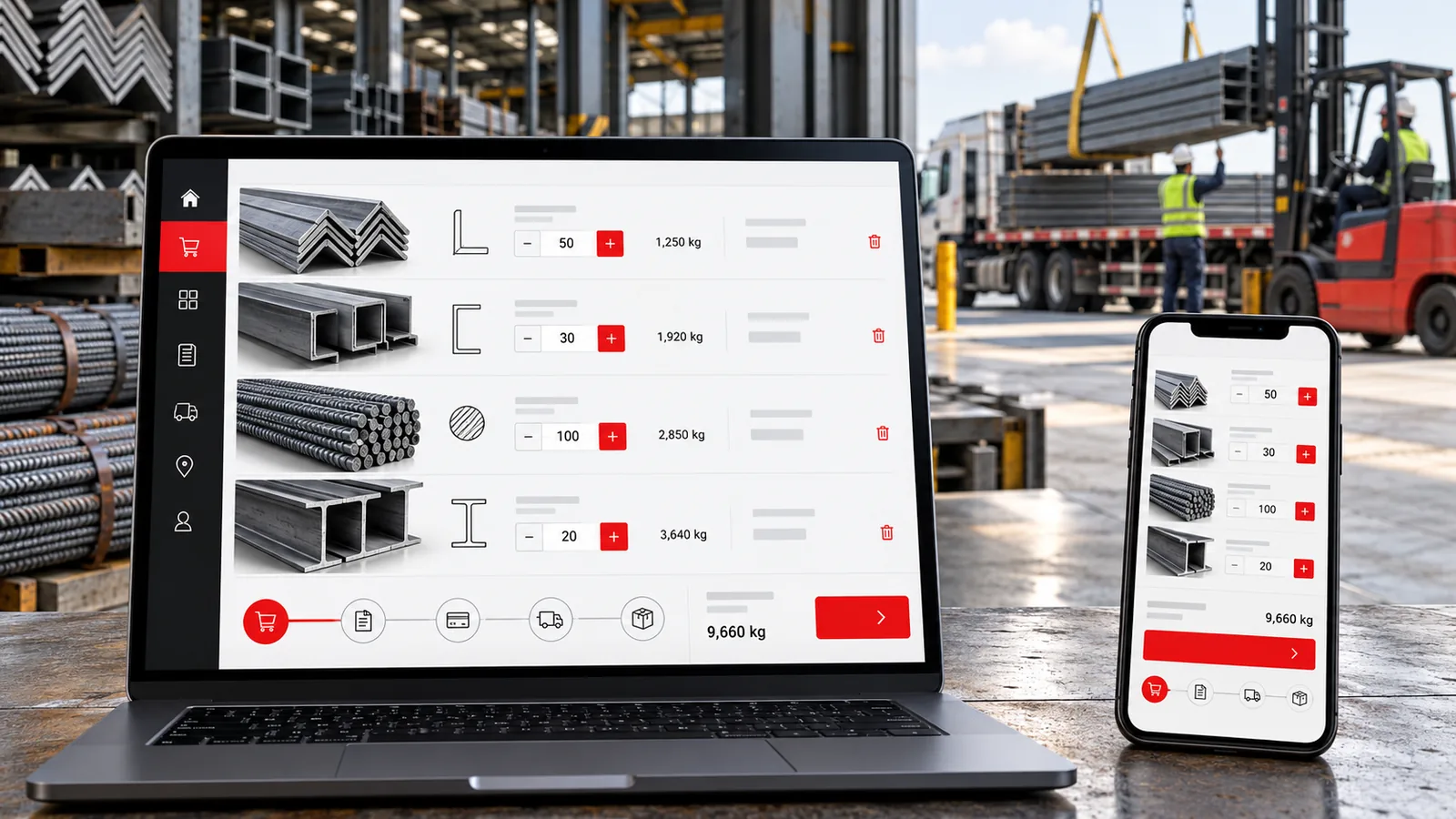
A proposed online order journey
The process can start with product and technical specification selection. The customer enters the required quantity, the system calculates weight and value, available price and stock information is checked, and an order or pro forma request is submitted. Depending on commercial policy, the next step may be sales approval, a defined online payment, or formal quotation issuance. After registration, the customer can follow the status of the request through an account area or notifications.
For customers, the main benefits are easier ordering, better transparency around weight and value, fewer unnecessary calls, and more accurate request registration. For the company, faster response, fewer manual errors, better order organization, and a stronger enquiry-to-sale process are the most important potential benefits.
In this architecture, the
steel price list
is no longer only a page for reading rates. It can become a direct entry point into calculation, selection, and quotation. The
sales contact
page remains important for project-based, negotiated, or technically complex orders.
Phase 4: an AI assistant specialized for steel customers
Phase 4 represents a more intelligent website experience: an AI-powered assistant that can answer part of the recurring customer questions, support product selection, perform basic calculations, and pass a better-prepared sales request to a human team. The purpose is not to replace experienced salespeople; it is to reduce friction in the early stages and help customers move forward faster.

What could the AI assistant do?
A customer could ask about price, product differences, technical specifications, approximate weight, or the purchasing process. The assistant would answer using approved website information, suggest products for further review when enough project context is provided, perform simple weight or value calculations, and—when the customer is ready—collect the information needed for a sales request.
Twenty-four-hour availability is an important advantage. Industrial customers often compare products outside office hours, and an immediate first response can prevent the buying journey from ending prematurely. At the same time, recurring questions become valuable data: the company can identify where customers are confused and improve product pages, technical content, and sales scripts accordingly.
Benefits for sales and marketing
If the assistant is connected to controlled sources such as product data, approved pricing, inventory, or CRM information, it can improve lead quality. A salesperson may receive not only a phone number but also the customer’s question history, product interest, estimated quantity, and context. That means less time is spent on repetitive questions and more time can be used for commercial negotiation and technical problem solving.
Management can also analyze common requests, frequently discussed products, visiting hours, and conversation drop-off points. Any AI deployment, however, must include response quality controls, clear data access rules, source traceability, and an easy handoff to a human expert when certainty is low.
Virtual factory tour: turning industrial trust into a digital experience
Another important extension is a virtual factory tour. In many B2B relationships, visiting the factory is part of trust building. Distance, travel constraints, scheduling, and international customers can make physical visits difficult. An interactive tour can transfer part of that experience to the website.

The proposed route can begin at the factory entrance and continue through the production line, quality control, finished-product warehouse, and loading area. A 360-degree view, selectable key points, multilingual descriptions, supporting images or video, and interactive navigation can create a richer experience than a conventional photo gallery.
Beyond marketing, the tour can support discussions about production capability, quality assurance, storage, and logistics. A multilingual version could be particularly useful for international customers who need to understand the facility before planning a visit or starting a commercial relationship.
How do these phases become one connected ecosystem?
The real value of the roadmap appears when the phases are not developed as isolated tools. A product viewed on a product page should be able to move into the calculator. A calculated basket should become a sales enquiry. That enquiry should be trackable in the sales system. KPI metrics should measure the results of those enquiries. Online orders should expose their status to the customer, and the AI assistant should rely on the same approved data sources.
In other words, the objective is not to build several disconnected widgets. It is to create a digital chain from visitor acquisition to customer conversion and performance analysis. When information flows between stages, the website becomes an operational asset whose contribution to sales and management can be measured.
How should success be measured?
The roadmap should begin with clear success metrics. Useful measures can include the number of qualified enquiries, response time, conversion rate, product-page engagement, calculator usage, online-order completion, reduction in repetitive calls, and customer satisfaction with the digital experience.
At later stages, the company can also monitor the number of AI-assisted enquiries, the percentage of questions resolved without human intervention, virtual-tour engagement, and whether those interactions are associated with commercial enquiries. Defining KPIs before development makes it easier to decide which features deserve expansion, revision, or a lower priority.
User experience, security, and data quality: three conditions for success
More functionality does not automatically mean a better industrial website. Every tool must remain clear, fast, and easy to use. A complicated calculator, a long order form, or an AI assistant that gives uncertain answers can reduce trust. User experience design therefore needs to evolve at the same time as technical functionality.
Security is equally important, especially around ordering, payment, user accounts, and integration with internal systems. Product specifications, prices, stock status, and calculated weights must come from controlled sources. An AI assistant should never present a guess as a confirmed technical or commercial fact.
Industrial digital products also require alignment between user experience, technical architecture, SEO, and brand identity. For an example of web and digital product design services, see
Brandamoon.
How would the roadmap change the customer experience?
In a traditional process, many steps are handled through repeated calls: ask about a product, request weight, ask for price, confirm stock, send a list, correct the order, and follow up again. The roadmap moves repeatable and standardized tasks into the website while keeping human interaction for situations that genuinely require negotiation or technical expertise.
Customers can reach an answer faster, orders can be recorded more accurately, and sales teams can spend more time on serious opportunities and complex projects. This is particularly valuable in B2B steel sales and multi-product orders.
Conclusion: from today’s website to tomorrow’s intelligent sales infrastructure
The Navard Foolad Parseh Kaveh website future vision is a phased path for digitizing customer experience and sales operations. Phase 1 provides the official information and content foundation. Phase 2 adds the order calculator and sales KPI layer. Phase 3 brings order registration into the website. Phase 4 introduces an intelligent assistant for faster customer guidance. A virtual factory tour adds transparency, experience, and trust to the same ecosystem.
The roadmap creates real value when development is phased, measurable, and directly linked to customer needs. The final goal is not simply to digitize a few forms; it is to build a system that combines better information, simpler customer journeys, more organized sales, and more precise management decisions.
Frequently asked questions about the NFPK digital roadmap
Are all the features described here already active?
No. The article presents the current website foundation together with planned future stages. Capabilities such as sales KPI dashboards, online ordering, and the AI assistant are presented as development phases and future vision.
What changes in Phase 2?
Phase 2 combines a steel basket calculator for customers with a sales KPI system for the company, allowing requests to become more structured and sales results to become measurable.
What would the online ordering process include?
The proposed flow includes product selection, quantity entry, weight and value calculation, quotation or order registration, sales review or approval, and order-status tracking.
How can AI be used on a steel website?
An AI assistant can answer recurring questions, retrieve approved product information, support initial product selection, perform simple calculations, and route a more complete request to a salesperson.
What can a virtual factory tour show?
The suggested key areas are the factory entrance, production line, quality control, product warehouse, and loading area, supported by 360-degree views and multilingual information.
How can the roadmap be evaluated?
Metrics such as qualified enquiries, response time, conversion rate, calculator usage, online-order completion, customer satisfaction, and sales performance can be used to measure impact.

Comments
0